
Tina Butler · 9 October 2026
Exploring Citation Networks in Niche Digital Transitions and Their Effects on Authority Signals
Digital transitions in specialized markets often involve shifts in how content references and links evolve over time, and citation networks play a central role in shaping authority signals that search systems and platforms use to evaluate credibility. Researchers track these networks as clusters of references that form around topics, and data from multiple studies show that transitions such as platform migrations or content format changes can redistribute citation flow in measurable ways. One analysis of web graphs conducted by academic teams found that authority metrics adjust when new nodes enter established networks, particularly in fields like health information or technical documentation where source reliability matters.
How Citation Networks Form During Niche Shifts
Specialized sectors experience digital transitions when organizations adopt new domains, content management systems, or distribution channels, and citation networks adapt through the addition or removal of linking pathways. Evidence from longitudinal web crawls indicates that these networks maintain core structures even as peripheral connections change, with authority signals depending on the density of incoming references from established sources. Observers note that in October 2026 several industry reports documented increased activity in citation redistribution following updates to major indexing protocols, and figures from those reports reveal patterns where niche sites gained or lost visibility based on their position within broader reference graphs.
Take the case of a technical documentation portal that moved its archive to a new subdomain structure, where citation data collected over six months showed a temporary dip in authority scores followed by recovery once external references stabilized. Studies from European research institutions highlight similar outcomes across multiple sectors, demonstrating that the speed of network reconnection correlates with the volume of pre-existing citations rather than the transition itself.
Measuring Authority Signals Through Network Metrics
Authority signals emerge from metrics such as citation count, reference diversity, and network centrality, all of which citation analysis tools quantify during digital changes. Data indicates that sites maintaining consistent inbound links from high-centrality nodes preserve stronger signals, whereas those relying on isolated clusters see diluted effects. Researchers at North American universities have mapped these dynamics using graph algorithms, and results show that transitions in niche markets amplify small differences in network position into larger variations in perceived authority.
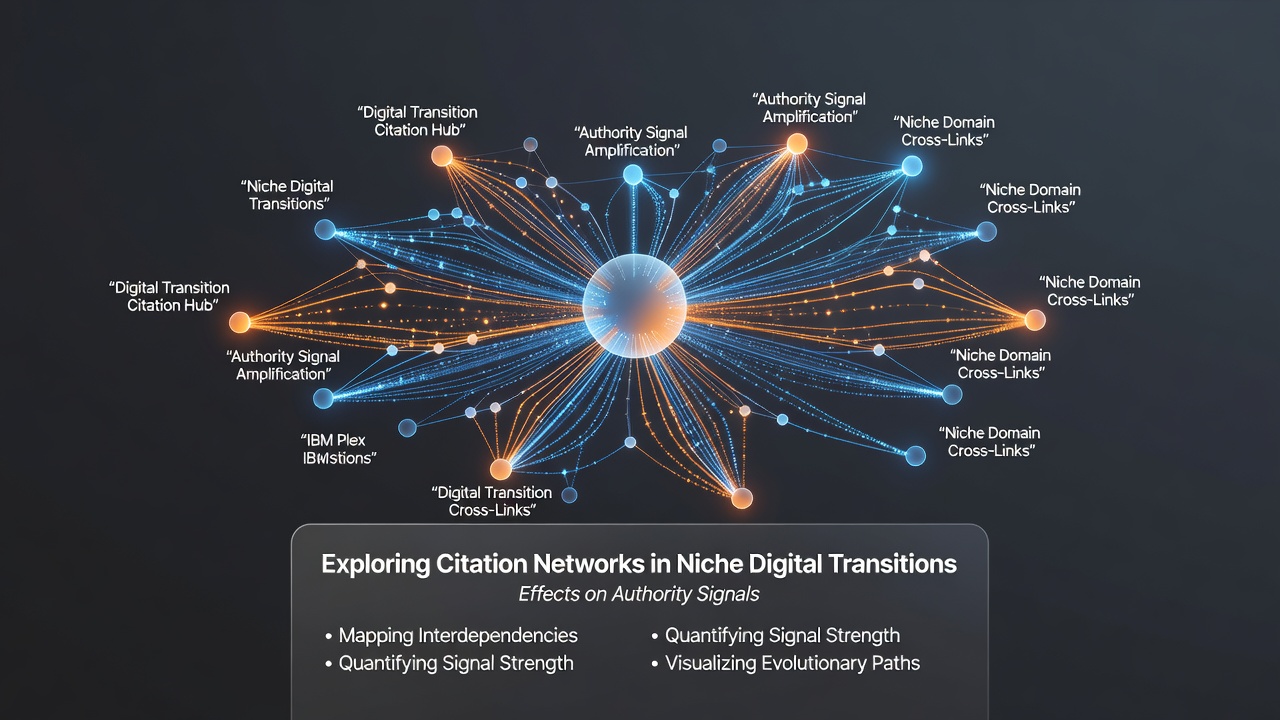
What's interesting is how geographic variations appear in the data, with reports from Australian regulatory bodies on digital content standards noting distinct citation patterns compared to those observed in Canadian academic surveys. These differences arise because local linking behaviors influence how networks reform after a transition, and evidence suggests that cross-border references can accelerate authority recovery when they connect to stable hubs.
Patterns Observed in Recent Transitions
Recent examinations of citation networks during niche digital transitions reveal recurring patterns, including the rapid formation of new bridges between old and new content locations. According to data compiled by international research consortia, sites that preserve historical citation anchors experience smoother authority signal continuity. One documented example involved a specialized agricultural information service that updated its online presence, after which network analysis showed sustained authority levels tied to references from government agricultural databases.
But here's the thing: transitions that coincide with broader indexing adjustments can produce compounding effects, as seen in October 2026 when several monitoring services reported simultaneous shifts across multiple niche categories. Those reports link the changes to both platform migrations and updates in how citation freshness factors into ranking systems, and the combined influence produced measurable variations in authority distribution.
Tools and Methods for Network Analysis
Analysts employ graph theory techniques and citation mapping software to examine these networks, with methods that include degree distribution calculations and community detection algorithms. Findings from university-led projects demonstrate that such tools identify influential nodes whose references carry disproportionate weight during transition periods. Industry organizations focused on information science have published guidelines that detail how practitioners apply these methods to track authority signals without relying on single-point metrics.
Turns out that integrating temporal data into network models improves prediction accuracy, according to comparative studies that tested static versus dynamic approaches. External references from established repositories, such as those maintained by the National Institutes of Health, often serve as anchors that stabilize signals across transitions in health-related niches.
Conclusion
Citation networks continue to influence authority signals as niche digital transitions unfold, with evidence from ongoing research showing that network structure and reference quality determine how signals evolve. Data collected through 2026 underscores the value of monitoring these networks during platform or domain changes, and patterns identified across regions provide a factual basis for understanding the mechanisms at work. Further examination of citation dynamics will likely refine current models as additional transition cases become available for analysis.